
Comparing EMDR vs. Traditional Talk Therapy for Trauma

Trauma affects people in deeply personal and complex ways. For many, healing requires professional support. But with so many therapeutic options, how do you choose the right one? When you partner with KG Counseling, licensed clinical social worker Karen Geren brings over 20 years of experience helping individuals navigate this very question. In this blog, we’ll explore two widely used approaches: EMDR (Eye Movement Desensitization and Reprocessing) and traditional talk therapy, comparing how each method works, their benefits, and how to determine what might be right for you.
What is EMDR Therapy?
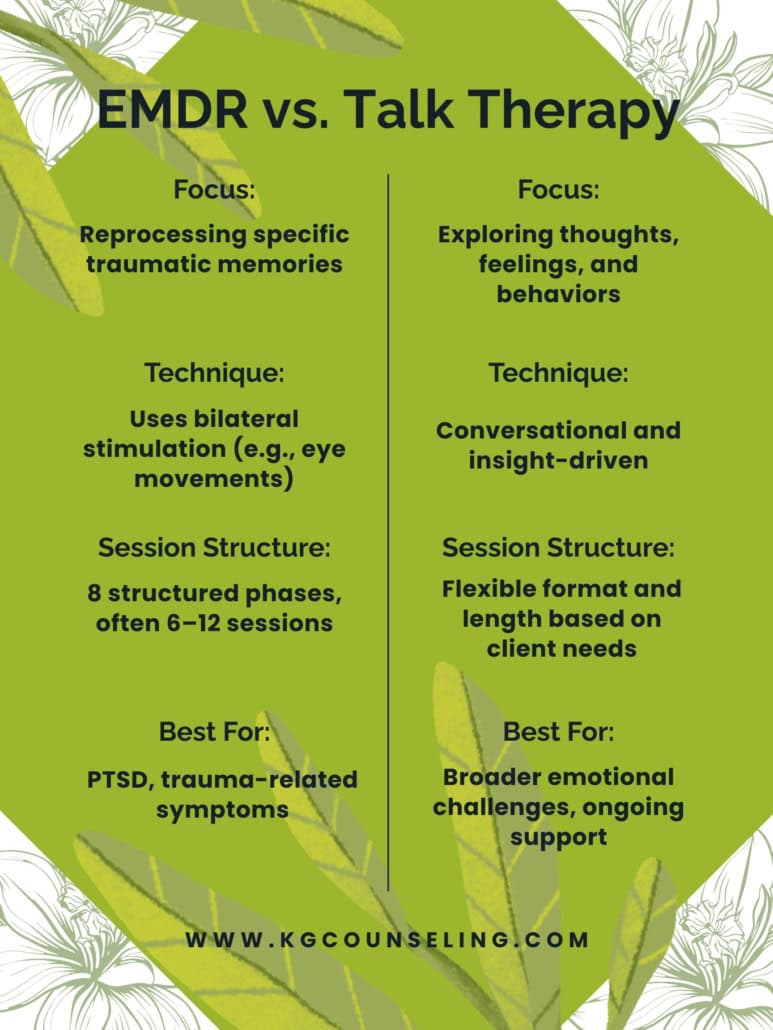
EMDR is a structured, evidence-based therapy designed to help people reprocess and heal from traumatic memories. It involves a series of phases that use bilateral stimulation (often eye movements or tapping) to activate the brain’s natural healing processes. Unlike traditional talk therapy, EMDR doesn’t require clients to describe the trauma in detail. Instead, it helps desensitize the emotional intensity tied to traumatic memories, allowing for healthier cognitive and emotional integration.
This trauma-focused therapy is rooted in the Adaptive Information Processing model, which suggests that distressing memories can get “stuck” in the nervous system. EMDR works to help reprocess these memories, replacing negative beliefs with more adaptive, positive ones.
What to Expect with EMDR
- Sessions are structured into eight distinct reprocessing phases
- Focuses on identifying and targeting specific traumatic memories
- Uses eye movements, tapping, or auditory stimulation as bilateral stimulation techniques
- Helps address PTSD symptoms, dissociative symptoms, and intense emotions linked to traumatic experiences
Karen Geren is trained in EMDR and a member of the EMDR International Association, reflecting her commitment to using proven, research-backed methods in her counseling practice.
What is Traditional Talk Therapy?
Talk therapy, also called psychotherapy or individual therapy, involves speaking with a licensed mental health professional to explore thoughts, feelings, and behaviors. Modalities can include cognitive behavioral therapy (CBT), psychodynamic therapy, dialectical behavior therapy (DBT), and mindfulness-based approaches, among others. At its core, talk therapy is about building insight, developing coping skills, and making connections between past experiences and present challenges.
Traditional talk therapy is especially helpful for addressing mental health concerns beyond trauma, including anxiety, depression, and eating disorders. It creates space to examine negative thoughts, manage emotional systems, and gain insight into long-standing patterns.
What to Expect in Talk Therapy
- Sessions vary in format and frequency depending on client needs and mental health conditions
- May be short-term or long-term depending on therapy goals
- Involves open conversation, emotional exploration, and skill-building exercises
- Offers space to process traumatic memories, past traumas, or ongoing mental health issues
- Includes strategies like journaling, goal-setting, and mindfulness to support growth and healing
Here at KG Counseling, Karen draws from a variety of therapeutic tools in talk therapy—including DBT skills training, journaling exercises, and mindfulness techniques—to create personalized and empowering treatment plans.
EMDR vs. Talk Therapy: Mechanisms of Change
Although both EMDR and talk therapy aim to support trauma recovery, they work in fundamentally different ways. Understanding the unique mechanism behind each approach can help you identify which method best aligns with your comfort level and treatment goals.
EMDR:
- Reprocesses traumatic memories using bilateral stimulation
- Targets the emotional and physiological distress tied to trauma
- Often requires fewer sessions than talk therapy for PTSD
- Doesn’t rely heavily on verbal narration of trauma
- May be ideal for individuals experiencing posttraumatic stress disorder, dissociative symptoms, or other negative symptoms related to traumatic events
EMDR is particularly effective for individuals who feel overwhelmed by traditional discussion-based therapy. The structure and pacing make it a focused intervention for reducing emotional reactivity to specific events.
Talk Therapy:
- Uses dialogue to uncover and process traumatic experiences
- Offers flexibility to address a broad range of emotional issues and mental health concerns
- Encourages long-term coping strategies and self-awareness
- Builds a strong therapeutic relationship over time
- May include trauma-focused modalities such as cognitive processing therapy and prolonged exposure
Talk therapy creates space for reflection, insight, and emotional processing. It’s ideal for those looking to explore past and present patterns, work through multiple concerns, and develop life skills in a supportive setting.
Learn more about trauma therapy services at KG Counseling
Which Is More Effective?
Numerous studies suggest that EMDR can be as effective—or even more effective—than traditional talk therapy in reducing symptoms of PTSD. A 2018 meta-analysis published in Frontiers in Psychology found that EMDR produced larger effect sizes in reducing trauma-related symptoms than cognitive behavioral therapy (CBT) in some cases.
That said, talk therapy remains a powerful and time-tested approach, especially when trauma is intertwined with broader emotional challenges like anxiety, depression, or relationship issues. For some clients, a blended or phased approach works best: EMDR to target traumatic memories and talk therapy to build coping skills and insight.
How to Choose the Right Therapy for You
Choosing between EMDR and talk therapy depends on your specific needs, comfort level, and goals. If you find it difficult to talk about your trauma or want to focus on processing specific memories, EMDR may be a better fit. If you’re looking for a safe space to explore emotional patterns, increase self-awareness, or address multiple concerns, traditional talk therapy might be the way to go.
Karen’s holistic approach ensures that each client receives a treatment plan designed around their life story, emotional goals, and personal preferences. Her diverse therapeutic toolbox allows for blending modalities when appropriate, giving clients the flexibility to evolve over time.
The Path to Healing
Both EMDR and talk therapy are valuable tools in trauma recovery. At KG Counseling, Karen Geren leverages decades of experience, clinical expertise, and a compassionate, client-centered philosophy to help each individual heal in a way that feels authentic and empowering. Whether you’re treating PTSD, addressing negative beliefs from past traumas, or managing broader mental health issues, KG Counseling is here to help.
Ready to start your trauma therapy journey with a trusted professional? Contact KG Counseling today.
Need Help Now? Explore These Resources


